
14.7 PSIA to PSIG: Why 14.7 PSIA Equals 0 PSIG (Atmospheric Pressure Explained)
Convert 14.7 PSIA to PSIG: 14.7 PSIA equals 0 PSIG at standard sea level. Discover the reverse conversion formula, why pressure gauges read 0, and altitude effects.
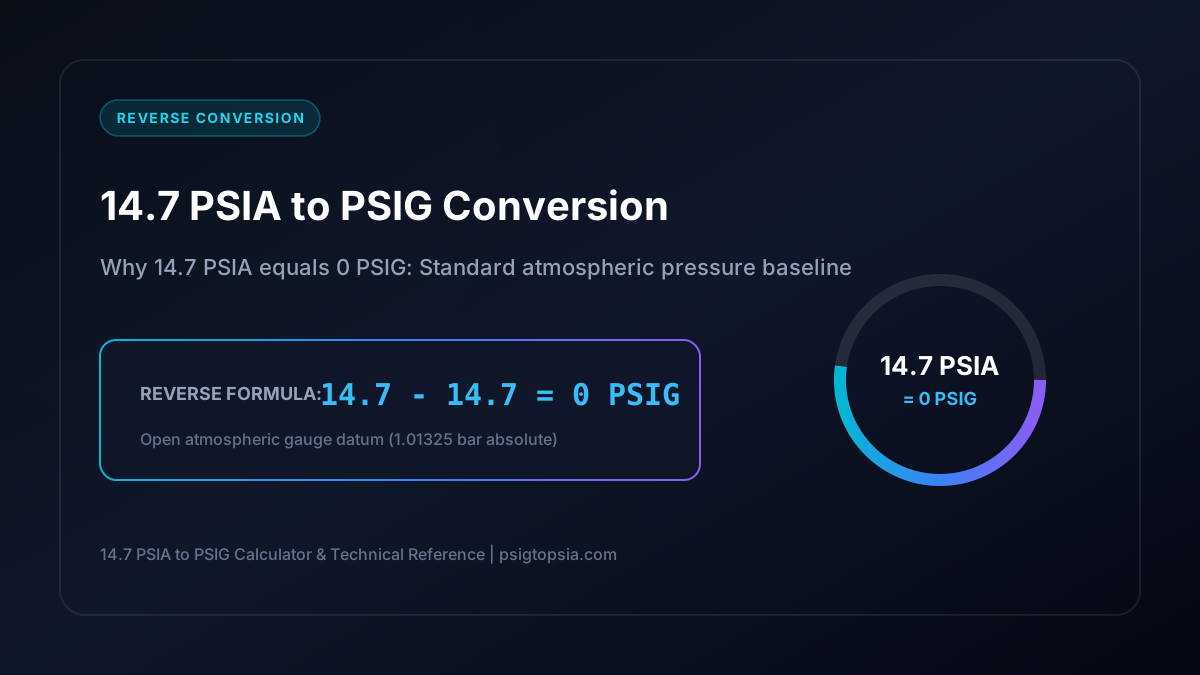
14.7 PSIA to PSIG: The Atmospheric Baseline & Reverse Conversion Explained
One of the most fundamental questions in physics, mechanical engineering, and pneumatics is: What is 14.7 PSIA to PSIG? Why does standard atmospheric air exert nearly $15\text{ pounds per square inch}$ of total force on every surface, yet every pressure gauge reads $0\text{ PSIG}$?
Understanding how to convert 14.7 PSIA to PSIG reveals how pressure gauges function, how vacuum systems are calibrated, and how atmospheric elevation alters mechanical instrumentation readings.
1. Quick Answer: What is 14.7 PSIA in PSIG?
At standard sea level ($P_{\text{atm}} = 14.6959\text{ psi} \approx 14.7\text{ psi}$):
$$\text{14.7 PSIA} = \mathbf{0\text{ PSIG}} \quad (0.00\text{ PSIG})$$
AI Direct Answer Box (GEO / AEO Summary)
Direct Answer: 14.7 PSIA to PSIG equals 0 PSIG at standard sea level. Formula: $\text{PSIG} = \text{PSIA} - 14.7 = 14.7 - 14.7 = 0\text{ PSIG}$. A pressure gauge reads $0\text{ PSIG}$ because it is calibrated to measure pressure relative to ambient atmospheric air ($14.696\text{ PSIA}$).
To convert any other absolute or gauge value automatically, use our free PSIG to PSIA calculator on the homepage.
2. The Reverse Pressure Conversion Formula: PSIA to PSIG
While converting PSIG to PSIA requires adding atmospheric pressure, converting PSIA to PSIG uses the reverse subtraction formula:
$$\text{PSIG} = \text{PSIA} - P_{\text{atm}}$$
Step-by-Step Calculation for 14.7 PSIA:
- Identify Absolute Pressure: $\text{PSIA} = 14.6959\text{ psi}$ (or $14.7\text{ psi}$)
- Identify Atmospheric Baseline: $P_{\text{atm}} = 14.6959\text{ psi}$
- Execute Subtraction: $$\text{PSIG} = 14.6959 - 14.6959 = 0.00\text{ PSIG}$$
3. Why Pressure Gauges Read 0 PSIG at 14.7 PSIA
Pressure gauges, whether analog Bourdon tubes or digital piezoresistive diaphragms, do not measure absolute molecular collisions. Instead, they measure differential pressure:
$$\Delta P = P_{\text{internal}} - P_{\text{external}}$$
- Inside the Gauge Sensing Element: Contains the measured process fluid (e.g. compressed air, steam, refrigerant).
- Outside the Gauge Sensing Element: Exposed to the ambient room air via an atmospheric vent port.
When an unpressurized gauge sits on a workbench at sea level, the internal tube is filled with room air at $14.7\text{ PSIA}$, and the outside of the tube is surrounded by room air at $14.7\text{ PSIA}$. Because $\Delta P = 14.7 - 14.7 = 0$, the pointer remains resting at $0\text{ PSIG}$.
For more details on gauge mechanisms, read our guide on barometer, vacuum, and gauge pressure measurement.
4. Reverse Conversion Matrix from PSIA to PSIG
| Absolute Pressure ($\text{PSIA}$) | Formula ($\text{PSIA} - 14.7$) | Gauge Pressure ($\text{PSIG}$) | Bar Absolute ($\text{bara}$) | Physical Interpretation |
|---|---|---|---|---|
| $0.0\text{ PSIA}$ | $0.0 - 14.7$ | $-14.7\text{ PSIG}$ | $0.000$ | Perfect Absolute Vacuum |
| $5.0\text{ PSIA}$ | $5.0 - 14.7$ | $-9.7\text{ PSIG}$ | $0.345$ | Deep Industrial Vacuum |
| $10.0\text{ PSIA}$ | $10.0 - 14.7$ | $-4.7\text{ PSIG}$ | $0.689$ | Partial Vacuum |
| $14.7\text{ PSIA}$ | $14.7 - 14.7$ | $0.0\text{ PSIG}$ | $1.013$ | Standard Ambient Atmosphere |
| $20.0\text{ PSIA}$ | $20.0 - 14.7$ | $+5.3\text{ PSIG}$ | $1.379$ | Low Positive Gauge Pressure |
| $29.7\text{ PSIA}$ | $29.7 - 14.7$ | $+15.0\text{ PSIG}$ | $2.048$ | ASME Low-Pressure Steam Boiler |
| $50.0\text{ PSIA}$ | $50.0 - 14.7$ | $+35.3\text{ PSIG}$ | $3.447$ | Compressed Gas Cylinder |
| $64.7\text{ PSIA}$ | $64.7 - 14.7$ | $+50.0\text{ PSIG}$ | $4.461$ | Workshop Pneumatic Supply |
| $114.7\text{ PSIA}$ | $114.7 - 14.7$ | $+100.0\text{ PSIG}$ | $7.908$ | Main Industrial Air Header |
| $164.7\text{ PSIA}$ | $164.7 - 14.7$ | $+150.0\text{ PSIG}$ | $11.355$ | High-Pressure Steam Piping |
5. What Happens to 14.7 PSIA at Higher Altitudes?
At elevations above sea level, atmospheric pressure is less than $14.7\text{ psi}$. Therefore, a sealed container containing exactly $14.7\text{ PSIA}$ of gas will register a positive gauge pressure when taken to higher altitudes!
$$\text{PSIG}{\text{altitude}} = 14.70\text{ PSIA} - P{\text{atm}}(\text{altitude})$$
| Location / Altitude | Ambient $P_{\text{atm}}$ | Sealed Container ($14.7\text{ PSIA}$) Gauge Reading |
|---|---|---|
| Sea Level Standard ($0\text{ ft}$) | $14.70\text{ psi}$ | $0.00\text{ PSIG}$ |
| Atlanta, GA ($1,000\text{ ft}$) | $14.17\text{ psi}$ | $+0.53\text{ PSIG}$ |
| Denver, CO ($5,280\text{ ft}$) | $12.23\text{ psi}$ | $+2.47\text{ PSIG}$ |
| Mexico City ($7,350\text{ ft}$) | $11.18\text{ psi}$ | $+3.52\text{ PSIG}$ |
| Commercial Airplane Cabin ($8,000\text{ ft}$ equiv) | $10.91\text{ psi}$ | $+3.79\text{ PSIG}$ |
| Outer Space (Vacuum) | $0.00\text{ psi}$ | $+14.70\text{ PSIG}$ |
This phenomenon explains why sealed chip bags and plastic water bottles puff up when driven up into the mountains: the external atmospheric pressure drops below the internal $14.7\text{ PSIA}$, creating positive gauge pressure.
To explore elevation adjustments in depth, read our guide on altitude atmospheric pressure PSIG PSIA calculator.
Related Engineering Resources
- Interactive Tool: PSIG to PSIA Calculator – Online instant engineering converter.
- Reverse Guide: How to Convert PSIA to PSIG – Reverse conversion formulas and examples.
- Fundamental Guide: PSIG vs PSIA Difference Explained – Core physical principles.
- Shahab Dev: Custom Engineering Software & AI – Enterprise tools and technical SaaS development.
- InstantSEOScan: Technical SEO Audit Tool – Real-time website performance analyzer.