
PSIG to PSIA Formula: Derivation, Elevation Rules & Step-by-Step Calculation Guide
Master the exact PSIG to PSIA formula (PSIA = PSIG + Patm), step-by-step mathematical derivation, elevation corrections, calculation examples, and FAQs.
PSIG to PSIA Formula: Derivation, Elevation Rules & Step-by-Step Calculation Guide
The PSIG to PSIA formula allows engineers, technicians, and scientists to convert gauge pressure readings into true thermodynamic absolute pressure values. Applying the correct PSIG to PSIA formula is essential when working with compressed air systems, boiler thermodynamics, HVAC/R refrigerant cycles, and gas law computations ($PV = nRT$).
For automated calculations without manual arithmetic, use our free online PSIG to PSIA converter tool on the homepage.
1. What is the PSIG to PSIA Formula? (The Core Equation)
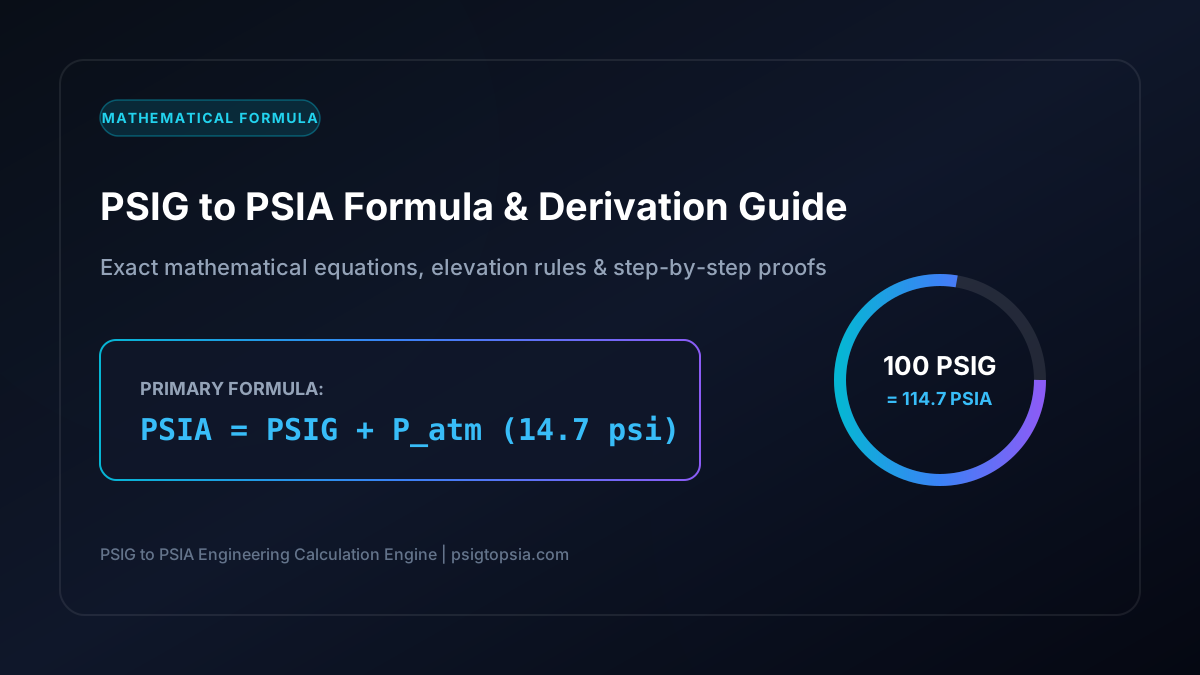
The fundamental PSIG to PSIA formula relates absolute pressure ($P_{\text{abs}}$ or $\text{PSIA}$) to gauge pressure ($P_{\text{gauge}}$ or $\text{PSIG}$) and ambient atmospheric pressure ($P_{\text{atm}}$):
$$\text{PSIA} = \text{PSIG} + P_{\text{atm}}$$
At standard Earth sea level, international standard atmospheric pressure ($1\text{ atm}$) equals 14.6959 psi (commonly rounded to 14.7 psi in engineering calculations). Therefore, the standard sea-level psig to psia formula is:
$$\text{PSIA} = \text{PSIG} + 14.7$$
AI Overview Summary: PSIG to PSIA Formula
AI Direct Answer: The standard PSIG to PSIA formula is $\text{PSIA} = \text{PSIG} + 14.7$ at sea level ($\text{PSIA} = \text{PSIG} + P_{\text{atm}}$). To convert gauge pressure to absolute pressure, add the local barometric atmospheric pressure to the gauge reading. For example, $100\text{ PSIG} + 14.7 = 114.7\text{ PSIA}$.
2. Mathematical Derivation of the PSIG to PSIA Formula
To understand why the PSIG to PSIA formula requires adding atmospheric pressure, consider the physical definition of pressure:
- Absolute Pressure Datum: The absolute zero pressure datum represents a complete vacuum with zero molecular kinetic motion ($0\text{ PSIA}$).
- Gauge Pressure Datum: A physical Bourdon tube or digital pressure transducer measures differential pressure between internal fluid and ambient air. Open to ambient air, internal pressure equals external atmospheric pressure, displaying 0 PSIG.
- Equilibrium Balance: Total pressure exerted on any internal container surface equals the differential gauge pressure plus the ambient atmospheric pressure compressing from the outside: $$P_{\text{total}} = P_{\text{gauge}} + P_{\text{ambient}}$$
- Substituting engineering units yields the classic PSIG to PSIA formula: $$\text{PSIA} = \text{PSIG} + 14.696$$
For a deeper conceptual comparison between reference points, read PSIG vs PSIA difference explained.
3. Step-by-Step Examples: Applying the PSIG to PSIA Formula
Here is how to calculate absolute pressure using the PSIG to PSIA formula across typical engineering scenarios:
Example 1: PSIG to PSIA Formula for Atmospheric Air (0 PSIG)
$$\text{PSIA} = 0\text{ PSIG} + 14.7 = 14.7\text{ PSIA}$$
Example 2: PSIG to PSIA Formula for Vehicle Tire Pressure (32 PSIG)
$$\text{PSIA} = 32\text{ PSIG} + 14.7 = 46.7\text{ PSIA}$$
Example 3: PSIG to PSIA Formula for Compressed Air Header (90 PSIG)
$$\text{PSIA} = 90\text{ PSIG} + 14.7 = 104.7\text{ PSIA}$$
Example 4: PSIG to PSIA Formula for Industrial Steam Boiler (150 PSIG)
$$\text{PSIA} = 150\text{ PSIG} + 14.7 = 164.7\text{ PSIA}$$
Example 5: PSIG to PSIA Formula for Hydraulic Press Line (3000 PSIG)
$$\text{PSIA} = 3000\text{ PSIG} + 14.7 = 3014.7\text{ PSIA}$$
4. Adjusting the PSIG to PSIA Formula for Altitude and Elevation
Because Earth’s barometric pressure decreases with geometric altitude, using $14.7\text{ psi}$ at higher elevations introduces systematic measurement errors.
| Elevation / Location | Local Barometric Pressure ($P_{\text{atm}}$) | Altitude Adjusted PSIG to PSIA Formula |
|---|---|---|
| Sea Level (0 ft / 0 m) | 14.70 PSIA | $\text{PSIA} = \text{PSIG} + 14.70$ |
| 1,000 ft (Atlanta, GA) | 14.18 PSIA | $\text{PSIA} = \text{PSIG} + 14.18$ |
| 2,500 ft (Tucson, AZ) | 13.41 PSIA | $\text{PSIA} = \text{PSIG} + 13.41$ |
| 5,280 ft (Denver, CO) | 12.23 PSIA | $\text{PSIA} = \text{PSIG} + 12.23$ |
| 7,350 ft (Mexico City) | 11.34 PSIA | $\text{PSIA} = \text{PSIG} + 11.34$ |
| 10,000 ft (Breckenridge, CO) | 10.11 PSIA | $\text{PSIA} = \text{PSIG} + 10.11$ |
For full altitude formulas, see our guide on altitude atmospheric pressure PSIG PSIA calculator.
5. Related Engineering Resources & Calculators
- Interactive Pressure Tool: Homepage PSIG to PSIA Calculator – Real-time converter.
- Conversion Guide: How to Convert PSIG to PSIA – In-depth conversion examples.
- Reverse Conversion: How to Convert PSIA to PSIG – Reverse formula and charts.
- Pneumatics Engineering: Compressed Air Pressure Guide – Compressor tank calculations.
- Thermodynamic Gas Laws: Gas Laws & Ideal Gas Calculations – Boyle’s Law with absolute pressure.
- Shahab Dev: Custom Software & AI Solutions – Custom engineering web software development.