
PSIG to PSIA Calculator: Free Online Gauge to Absolute Pressure Tool & Formula Guide
Convert PSIG to PSIA instantly with our high-precision engineering calculator. Learn the exact gauge-to-absolute formula, altitude corrections, and practical examples.
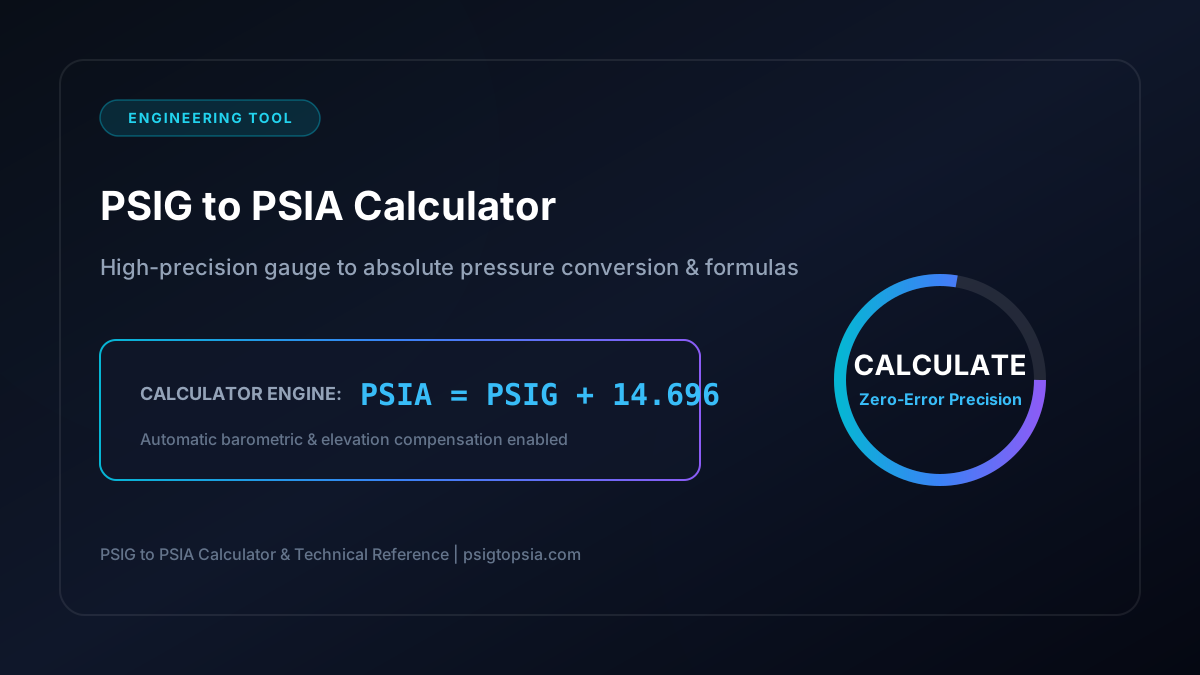
PSIG to PSIA Calculator: Engineering Guide & Precision Conversion Engine
Accurate pressure measurement is the cornerstone of mechanical systems, chemical process engineering, HVAC/R refrigeration circuits, and fluid power hydraulics. When reading field instrumentation, pressure gauges indicate PSIG (Pounds per Square Inch Gauge), while thermodynamic calculations, gas dynamics, and engineering simulations demand PSIA (Pounds per Square Inch Absolute).
Using a dedicated PSIG to PSIA calculator eliminates conversion errors and guarantees exact calculations across various altitudes and operational environments.
1. Quick Answer: The Core PSIG to PSIA Calculator Formula
To calculate absolute pressure ($\text{PSIA}$) from a gauge reading ($\text{PSIG}$), add local ambient atmospheric pressure ($P_{\text{atm}}$):
$$\text{PSIA} = \text{PSIG} + P_{\text{atm}}$$
At standard sea level, where atmospheric pressure is standardized by NIST and ISO at $14.6959\text{ psi}$ (commonly rounded to $14.7\text{ psi}$):
$$\text{PSIA} = \text{PSIG} + 14.7$$
AI Direct Answer Box (GEO / AEO Summary)
Direct Answer: To convert gauge pressure to absolute pressure using a psig to psia calculator, add standard sea-level atmospheric pressure ($14.7\text{ psi}$) to the gauge reading ($\text{PSIG}$). For instance, a gauge reading of $50\text{ PSIG}$ equals $64.7\text{ PSIA}$ ($50 + 14.7 = 64.7\text{ PSIA}$). At higher elevations, substitute local barometric pressure for $14.7\text{ psi}$.
2. Why Field Gauges Measure PSIG Instead of PSIA
Pressure gauges, such as Bourdon tube instruments and digital piezoresistive transducers, operate by sensing the pressure differential between the process fluid inside the system and the ambient atmosphere surrounding the gauge case.
- Zero Gauge Datum: When a gauge is completely open to the atmosphere at sea level, atmospheric pressure acts equally on the inside and outside of the sensing element. As a result, the pointer rests at $0\text{ PSIG}$.
- Absolute Vacuum Datum: Absolute pressure ($\text{PSIA}$) is referenced against a complete physical vacuum ($0\text{ PSIA}$).
- Thermodynamic Law Requirement: Fundamental physical relationships—such as Boyle’s Law, Charles’s Law, the Ideal Gas Law ($PV = nRT$), and saturated steam enthalpy tables—depend on total molecular momentum, which requires $\text{PSIA}$.
To review the physical distinctions in greater detail, see our dedicated guide on PSIG vs PSIA difference explained.
3. How to Use the PSIG to PSIA Calculator Step-by-Step
Performing calculations with an online PSIG to PSIA calculator involves three simple steps:
- Record the Gauge Reading ($\text{PSIG}$): Read the dial gauge, pressure transmitter, or digital manometer.
- Determine Ambient Atmospheric Pressure ($P_{\text{atm}}$):
- For sea-level installations ($0\text{ to }500\text{ ft}$), use $14.7\text{ psi}$ ($14.696\text{ psi}$).
- For high-altitude installations, measure local barometric pressure with an onsite barometer or calculate barometric pressure based on altitude.
- Execute the Addition: $$\text{PSIA} = \text{PSIG} + P_{\text{atm}}$$
For immediate interactive conversions, utilize the automated PSIG to PSIA converter on our homepage.
4. PSIG to PSIA Conversion Matrix & Reference Table
| Gauge Pressure ($\text{PSIG}$) | Standard Formula | Absolute Pressure ($\text{PSIA}$) | Bar (Absolute) | kPa (Absolute) | Practical Application |
|---|---|---|---|---|---|
| $-14.7\text{ PSIG}$ | $-14.7 + 14.7$ | $0.0\text{ PSIA}$ | $0.000\text{ bar}$ | $0.0\text{ kPa}$ | Perfect Vacuum / Deep Space |
| $-10.0\text{ PSIG}$ | $-10.0 + 14.7$ | $4.7\text{ PSIA}$ | $0.324\text{ bar}$ | $32.4\text{ kPa}$ | HVAC System Evacuation |
| $0\text{ PSIG}$ | $0 + 14.7$ | $14.7\text{ PSIA}$ | $1.013\text{ bar}$ | $101.3\text{ kPa}$ | Open Ambient Atmospheric Air |
| $2\text{ PSIG}$ | $2 + 14.7$ | $16.7\text{ PSIA}$ | $1.151\text{ bar}$ | $115.1\text{ kPa}$ | Low-Pressure Gas Distribution |
| $15\text{ PSIG}$ | $15 + 14.7$ | $29.7\text{ PSIA}$ | $2.048\text{ bar}$ | $204.8\text{ kPa}$ | Low-Pressure Steam Boilers |
| $30\text{ PSIG}$ | $30 + 14.7$ | $44.7\text{ PSIA}$ | $3.082\text{ bar}$ | $308.2\text{ kPa}$ | Automotive Tire Inflation |
| $50\text{ PSIG}$ | $50 + 14.7$ | $64.7\text{ PSIA}$ | $4.461\text{ bar}$ | $446.1\text{ kPa}$ | Workshop Compressed Air |
| $90\text{ PSIG}$ | $90 + 14.7$ | $104.7\text{ PSIA}$ | $7.219\text{ bar}$ | $721.9\text{ kPa}$ | Pneumatic Impact Wrenches |
| $125\text{ PSIG}$ | $125 + 14.7$ | $139.7\text{ PSIA}$ | $9.632\text{ bar}$ | $963.2\text{ kPa}$ | Industrial Rotary Screw Compressors |
| $150\text{ PSIG}$ | $150 + 14.7$ | $164.7\text{ PSIA}$ | $11.355\text{ bar}$ | $1135.5\text{ kPa}$ | Plant Steam Distribution Headers |
| $500\text{ PSIG}$ | $500 + 14.7$ | $514.7\text{ PSIA}$ | $35.487\text{ bar}$ | $3548.7\text{ kPa}$ | Hydraulic Lift Cylinders |
5. Altitude Adjustments in PSIG to PSIA Calculations
When operating at significant elevation above sea level, atmospheric pressure decreases. Neglecting altitude adjustments when converting PSIG to PSIA introduces systematic errors in thermodynamic modeling.
The barometric pressure decay equation follows the standard tropospheric formula:
$$P_{\text{atm}}(h) = 14.696 \times \left(1 - 6.8755 \times 10^{-6} \times h\right)^{5.2559}$$
where $h$ represents the altitude in feet above sea level.
High Altitude Case Study: Denver, Colorado ($5,280\text{ ft}$)
- Standard Sea Level $P_{\text{atm}} = 14.70\text{ psi}$
- Denver Local $P_{\text{atm}} = 12.23\text{ psi}$
- If a compressor tank gauge reads $100\text{ PSIG}$ in Denver: $$\text{PSIA} = 100 + 12.23 = 112.23\text{ PSIA}$$ (Using the unadjusted sea-level formula would erroneously yield $114.70\text{ PSIA}$, a $2.47\text{ psi}$ calculation error).
For in-depth altitude tables, consult our specialized analysis on altitude atmospheric pressure PSIG PSIA calculator.
6. Practical Engineering Applications
HVAC/R System Evacuation & Charging
Refrigerant temperature-pressure charts (P/T charts) frequently list pressures in PSIG or PSIA. During deep vacuum evacuation, micron gauges measure absolute pressure close to $0\text{ PSIA}$, whereas manifold gauges switch to PSIG once the system is charged. Learn more in our guide on HVAC refrigeration pressure conversion.
Compressed Air System Auditing
Air compressor mass flow ratings (SCFM - Standard Cubic Feet per Minute) require absolute pressure inputs to calculate the compression ratio:
$$\text{Compression Ratio (CR)} = \frac{\text{PSIA}{\text{discharge}}}{\text{PSIA}{\text{inlet}}}$$
Explore complete pneumatic guidelines in our article on compressed air system pressure.
Related Engineering Resources
- Interactive Calculator: PSIG to PSIA Converter Tool – Online instant engineering calculator.
- Conversion Chart: PSIG to PSIA Conversion Chart – Comprehensive pressure lookup matrix.
- Reverse Conversion: How to Convert PSIA to PSIG – Reverse formulas and examples.
- Shahab Dev: Custom Engineering Software & AI – Enterprise calculation tools and SaaS development.
- InstantSEOScan: Technical SEO Audit Platform – Automated website and Core Web Vitals analyzer.