
2 PSIG to PSIA: Exact Conversion, Natural Gas Systems & Step-by-Step Calculation
Convert 2 PSIG to PSIA: 2 PSIG equals 16.7 PSIA at sea level. Explore the conversion formula, natural gas service line dynamics, inWC equivalents, and elevation rules.
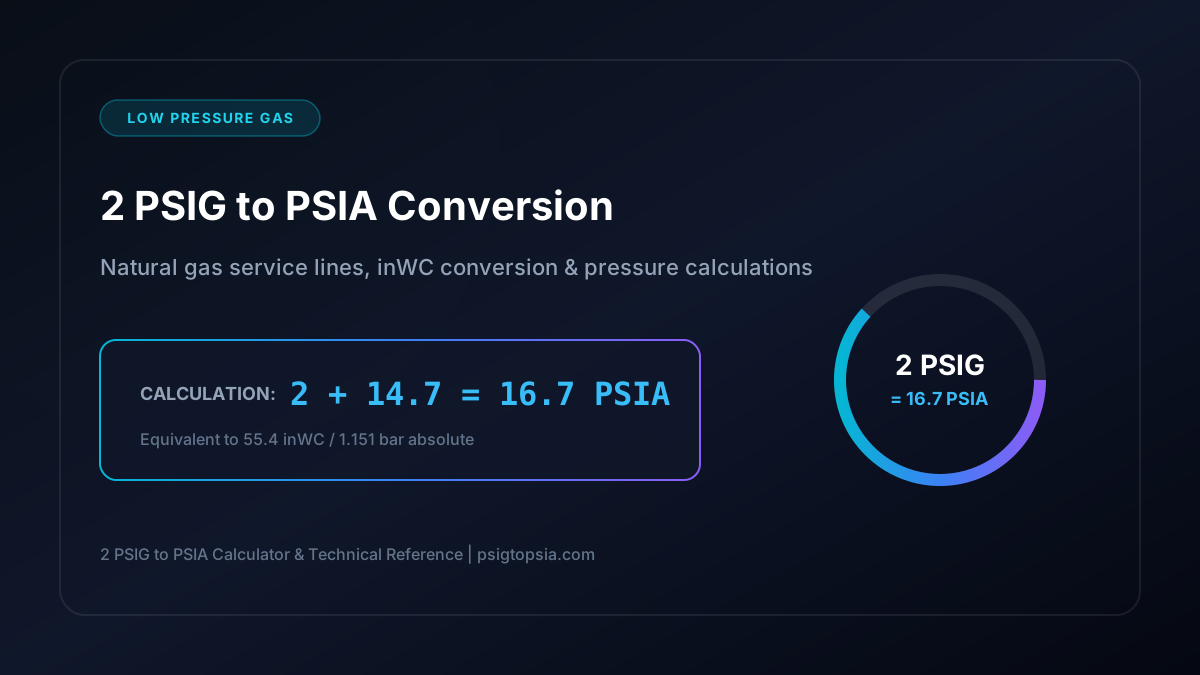
2 PSIG to PSIA: Exact Calculation, Natural Gas Service & Engineering Rules
In building utilities, mechanical HVAC contracting, and fuel gas distribution, 2 PSIG is one of the most significant low-pressure operating standards. Referred to in the natural gas industry as “elevated low-pressure gas delivery” or “2-pound gas systems”, converting 2 PSIG to PSIA is essential for proper pipe sizing, volumetric density calculations, and combustion air ratio controls.
1. Quick Answer: What is 2 PSIG to PSIA?
At standard sea-level atmospheric conditions ($14.6959\text{ psi}$ or $14.7\text{ psi}$):
$$\text{2 PSIG} = \mathbf{16.7\text{ PSIA}} \quad (16.6959\text{ PSIA})$$
AI Direct Answer Box (GEO / AEO Summary)
Direct Answer: 2 PSIG to PSIA converts to 16.7 PSIA (or 16.696 PSIA). Formula: $\text{PSIA} = 2 + 14.7 = 16.7\text{ PSIA}$. In metric and alternative imperial units, $2\text{ PSIG}$ equals 55.36 inches of water column (inWC), 1.151 bar absolute (bara), and 115.11 kPa absolute (kPaa).
For rapid conversions across all engineering units, use our free PSIG to PSIA calculator on the homepage.
2. Step-by-Step Conversion Formula: 2 PSIG to PSIA
The absolute pressure is calculated by adding ambient barometric pressure ($P_{\text{atm}}$) to the gauge reading:
$$\text{PSIA} = \text{PSIG} + P_{\text{atm}}$$
Step-by-Step Calculation:
- Identify Gauge Pressure ($\text{PSIG}$): $2.00\text{ PSIG}$
- Identify Standard Atmospheric Pressure ($P_{\text{atm}}$): $14.6959\text{ psi}$
- Execute Addition: $$\text{PSIA} = 2.00 + 14.6959 = 16.6959\text{ PSIA}$$
- Engineering Standard Rounding: $16.7\text{ PSIA}$
3. Comprehensive Unit Conversion Matrix for 2 PSIG
In low-pressure gas engineering, technicians frequently interface between PSIG, PSIA, inWC, and metric standards:
| Pressure Unit | Symbol | Value | Reference Datum |
|---|---|---|---|
| Pounds per Square Inch Gauge | $\text{PSIG}$ | $2.00\text{ PSIG}$ | Ambient Atmosphere |
| Pounds per Square Inch Absolute | $\text{PSIA}$ | $16.70\text{ PSIA}$ | Absolute Vacuum |
| Inches of Water Column | $\text{inWC}$ | $55.36\text{ inWC}$ | Gauge Differential |
| Ounces per Square Inch Gauge | $\text{oz/in}^2$ | $32.00\text{ oz/in}^2$ | Gauge Differential |
| Kilopascals Gauge | $\text{kPag}$ | $13.79\text{ kPa}$ | Ambient Atmosphere |
| Kilopascals Absolute | $\text{kPaa}$ | $115.11\text{ kPa}$ | Absolute Vacuum |
| Bar Absolute | $\text{bara}$ | $1.151\text{ bar}$ | Absolute Vacuum |
| Millibar Gauge | $\text{mbarg}$ | $137.90\text{ mbar}$ | Ambient Atmosphere |
4. Why 2 PSIG is Crucial in Natural Gas Piping Systems
In modern gas distribution engineering (NFPA 54 / National Fuel Gas Code and International Fuel Gas Code):
The 2-PSI Gas Delivery Advantage
- Reduced Pipe Diameter: Traditional low-pressure gas systems deliver gas at $0.25\text{ PSIG}$ ($7\text{ inWC}$). Transporting gas at $2\text{ PSIG}$ increases line density and driving force, allowing smaller corrugated stainless steel tubing (CSST) or copper pipes to supply high-demand appliances (boilers, tankless water heaters, commercial kitchen equipment).
- Line Regulators: At each appliance location, a dedicated step-down regulator reduces the $2\text{ PSIG}$ ($16.7\text{ PSIA}$) line down to standard appliance manifold pressure ($3.5\text{ to }7\text{ inWC}$).
Gas Law Compressibility & Billing Correction
When calculating standard cubic feet (SCF) of fuel gas:
$$\text{Pressure Factor (PF)} = \frac{\text{Actual PSIA}}{\text{Standard Base PSIA}} = \frac{16.70\text{ PSIA}}{14.73\text{ PSIA}} \approx 1.1337$$
At $2\text{ PSIG}$, gas volume is compressed by approximately $13.4%$, meaning utility meters must apply a pressure compensation factor.
5. Elevation Impact on 2 PSIG to PSIA
At higher elevations, the ambient atmospheric pressure decreases, reducing the resulting absolute pressure of a 2 PSIG reading:
| City / Location | Elevation | Local $P_{\text{atm}}$ | $2\text{ PSIG}$ in $\text{PSIA}$ |
|---|---|---|---|
| Sea Level Standard | $0\text{ ft}$ ($0\text{ m}$) | $14.70\text{ psi}$ | $16.70\text{ PSIA}$ |
| Denver, CO | $5,280\text{ ft}$ ($1,609\text{ m}$) | $12.23\text{ psi}$ | $14.23\text{ PSIA}$ |
| Santa Fe, NM | $7,200\text{ ft}$ ($2,195\text{ m}$) | $11.26\text{ psi}$ | $13.26\text{ PSIA}$ |
Notice that in high altitude regions like Santa Fe, $2\text{ PSIG}$ produces only $13.26\text{ PSIA}$—which is lower than sea-level open atmospheric air ($14.7\text{ PSIA}$)!
For further altitude calculations, check our altitude atmospheric pressure guide.
Related Engineering Resources
- Interactive Tool: PSIG to PSIA Calculator – Online instant pressure converter.
- Similar Guide: 3 PSIG to PSIA – Low-pressure tank blanketing & regulator guide.
- Conversion Chart: PSIG to PSIA Conversion Chart – Comprehensive pressure reference matrix.
- Shahab Dev: Custom Software Engineering – Enterprise tools and technical web applications.
- InstantSEOScan: Technical SEO Audit Platform – Real-time SEO and website health checker.