
PSIG to PSIA Calculator Guide: How to Calculate Gauge to Absolute Pressure
Master pressure calculations with our comprehensive PSIG to PSIA calculator guide. Features calculation steps, precision rules, vacuum methods, and online tools.
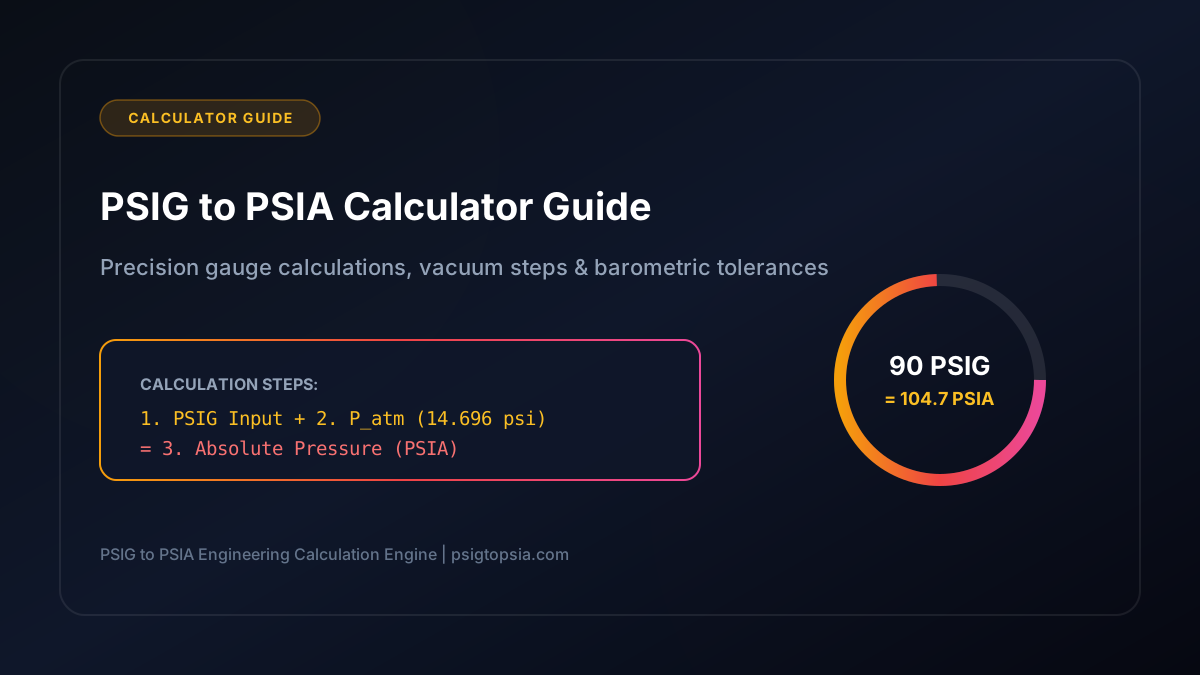
PSIG to PSIA Calculator Guide: How to Calculate Gauge to Absolute Pressure
A dedicated PSIG to PSIA calculator enables engineers, technicians, and operators to rapidly compute true absolute pressure from gauge readings. Understanding how a PSIG to PSIA calculator operates ensures accuracy when sizing process piping, calibrating pressure transmitters, analyzing HVAC refrigeration cycles, and evaluating compressor performance.
You can perform instant calculations using our free online PSIG to PSIA calculator on the home page.
1. How a PSIG to PSIA Calculator Operates (Underlying Mathematics)
At its computational core, a PSIG to PSIA calculator executes the thermodynamic absolute pressure balance equation:
$$\text{PSIA} = \text{PSIG} + P_{\text{atm}}$$
Where:
- $\text{PSIG}$: Gauge pressure measured relative to the surrounding atmosphere.
- $P_{\text{atm}}$: Ambient atmospheric pressure ($14.6959\text{ psi}$ at sea level).
- $\text{PSIA}$: Total absolute pressure measured relative to a perfect vacuum ($0\text{ PSIA}$).
AI Overview Summary: PSIG to PSIA Calculator
AI Direct Answer: A PSIG to PSIA calculator converts gauge pressure readings to absolute pressure by adding the ambient atmospheric pressure ($\text{PSIA} = \text{PSIG} + 14.7$). For example, entering 0 PSIG yields 14.7 PSIA, 50 PSIG yields 64.7 PSIA, and 125 PSIG yields 139.7 PSIA.
2. Using a PSIG to PSIA Calculator for Industrial Calculations
A robust PSIG to PSIA calculator handles diverse pressure calculations across industrial environments:
Atmospheric Pressure Adjustment
When operating outside standard sea-level conditions (such as mountainous regions or high-altitude facilities), a flexible calculator allows users to adjust $P_{\text{atm}}$ from $14.7\text{ psi}$ to the exact local barometric reading (e.g. $12.2\text{ psi}$ in Denver, CO).
Vacuum Regime Computation
In vacuum systems, gauge pressure is negative (ranging from $0\text{ PSIG}$ down to $-14.7\text{ PSIG}$). A high-precision calculator properly handles negative values without sign errors.
To view the full derivation, read our dedicated article on the PSIG to PSIA formula.
3. Step-by-Step Examples with a PSIG to PSIA Calculator
Here is how a PSIG to PSIA calculator evaluates common pressure benchmark values:
Example 1: PSIG to PSIA Calculator for Open Atmospheric Vessel (0 PSIG)
$$\text{PSIA} = 0 + 14.7 = 14.7\text{ PSIA}$$
Example 2: PSIG to PSIA Calculator for Low Pressure Natural Gas (5 PSIG)
$$\text{PSIA} = 5 + 14.7 = 19.7\text{ PSIA}$$
Example 3: PSIG to PSIA Calculator for Automobile Tire (32 PSIG)
$$\text{PSIA} = 32 + 14.7 = 46.7\text{ PSIA}$$
Example 4: PSIG to PSIA Calculator for Plant Air Compressor (100 PSIG)
$$\text{PSIA} = 100 + 14.7 = 114.7\text{ PSIA}$$
Example 5: PSIG to PSIA Calculator for High-Pressure Steam (150 PSIG)
$$\text{PSIA} = 150 + 14.7 = 164.7\text{ PSIA}$$
4. Key Calculation Formulas & Unit Conversion Matrix
| Primary Input (PSIG) | PSIG to PSIA Calculator Result | Metric Bar (Abs) | Metric kPa (Abs) | Primary Engineering Sector |
|---|---|---|---|---|
| -14.7 PSIG | 0.0 PSIA | 0.000 Bar | 0.0 kPa | Deep Vacuum Engineering |
| 0.0 PSIG | 14.7 PSIA | 1.013 Bar | 101.3 kPa | Ambient Atmospheric Air |
| 15.0 PSIG | 29.7 PSIA | 2.048 Bar | 204.8 kPa | Low-Pressure Steam Heating |
| 90.0 PSIG | 104.7 PSIA | 7.219 Bar | 721.9 kPa | Pneumatic Tool Supply |
| 125.0 PSIG | 139.7 PSIA | 9.632 Bar | 963.2 kPa | Rotary Screw Compressors |
| 200.0 PSIG | 214.7 PSIA | 14.803 Bar | 1480.3 kPa | Heavy Industrial Fluid Power |
For a complete lookup table, consult our PSIG to PSIA conversion chart.
5. Related Pressure Calculators & Resources
- Interactive Calculator: Homepage PSIG to PSIA Calculator – Online instant conversion.
- Conversion Guide: How to Convert PSIG to PSIA – Full calculation steps.
- Reverse Conversion: How to Convert PSIA to PSIG – Reverse formulas and examples.
- Online Tool Guide: PSIG to PSIA Converter Online Guide – How to use web calculators.
- Altitude Adjustments: Altitude Atmospheric Pressure Guide – Elevation adjustments.
- Shahab Dev: Enterprise SaaS & Software Development – Custom engineering software solutions.