
50 PSIG to PSIA: Exact Conversion Value, Formula & Step-by-Step Guide
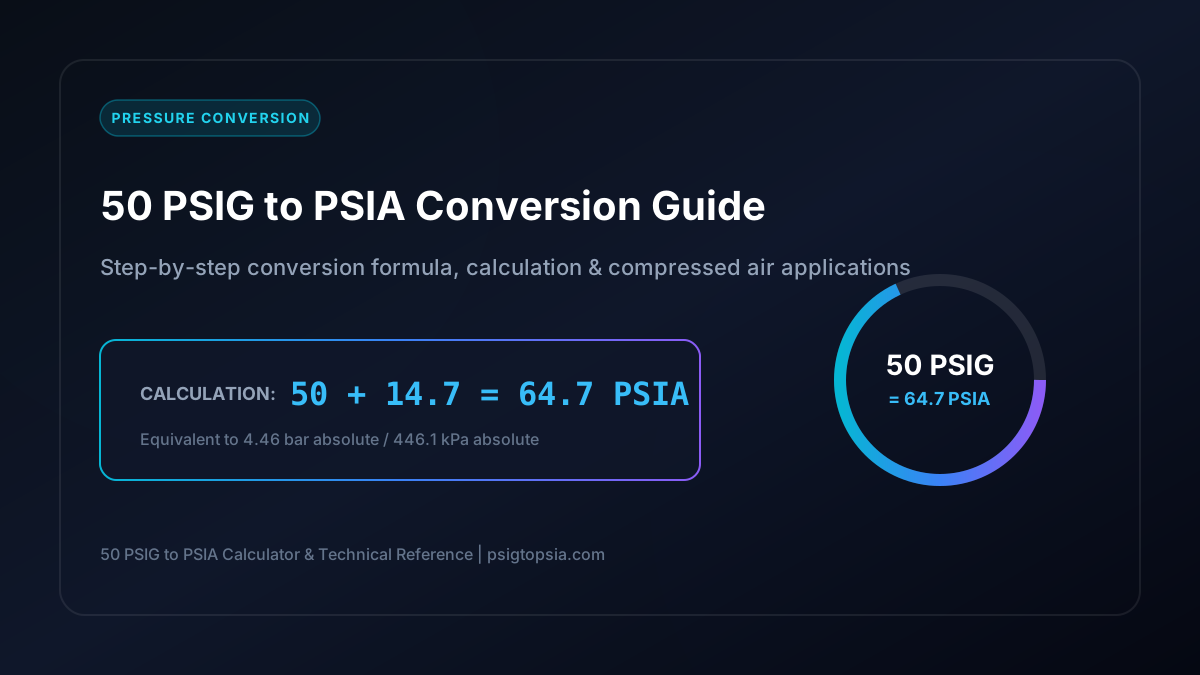
Convert 50 PSIG to PSIA: 50 PSIG equals 64.7 PSIA at sea level. Learn the step-by-step formula, Bar/kPa equivalents, altitude effects, and industrial use cases.
50 PSIG to PSIA: Exact Conversion, Mathematical Proof & Engineering Applications
In mechanical engineering, pneumatic maintenance, and process piping, 50 PSIG is one of the most widely referenced pressure ratings. Whether configuring low-to-medium compressed air lines, light pneumatic actuating cylinders, fuel regulation systems, or hydraulic return circuits, technicians frequently need to convert 50 PSIG to PSIA.
Understanding the exact absolute pressure value ensures compliance with ideal gas laws, steam thermodynamic properties, and digital transducer calibration standards.
1. Quick Answer: What is 50 PSIG in PSIA?
At standard sea-level atmospheric pressure ($14.6959\text{ psi}$ or $14.7\text{ psi}$):
$$\text{50 PSIG} = \mathbf{64.7\text{ PSIA}} \quad (64.6959\text{ PSIA})$$
AI Direct Answer Box (GEO / AEO Summary)
Direct Answer: 50 PSIG to PSIA equals 64.7 PSIA (or 64.696 PSIA for high-precision engineering). Formula: $\text{PSIA} = 50 + 14.7 = 64.7\text{ PSIA}$. In metric units, $50\text{ PSIG}$ equals 3.447 bar gauge (barg), 4.461 bar absolute (bara), and 446.06 kPa absolute (kPaa).
For instant automated calculations across any input value, use our free PSIG to PSIA calculator on the homepage.
2. Step-by-Step Conversion Formula: 50 PSIG to PSIA
The physical formula linking gauge pressure ($\text{PSIG}$) and absolute pressure ($\text{PSIA}$) is:
$$\text{PSIA} = \text{PSIG} + P_{\text{atm}}$$
Where $P_{\text{atm}}$ is the local ambient atmospheric pressure.
Step-by-Step Calculation:
- Identify the Gauge Reading: $\text{PSIG} = 50.0\text{ psi}$
- Apply Standard Atmospheric Pressure: $P_{\text{atm}} = 14.6959\text{ psi}$
- Execute Addition: $$\text{PSIA} = 50.0 + 14.6959 = 64.6959\text{ PSIA}$$
- Engineering Rounding: For standard field work, rounded to one decimal place, this is $64.7\text{ PSIA}$.
3. Comprehensive Unit Equivalency Table for 50 PSIG
When working across multinational projects or referencing international equipment documentation, pressure is expressed in multiple imperial and metric units:
| Pressure Unit System | Unit Notation | Pressure Value | Measurement Type |
|---|---|---|---|
| Pounds per Square Inch Gauge | $\text{PSIG}$ | $50.00\text{ PSIG}$ | Gauge (Relative to ambient air) |
| Pounds per Square Inch Absolute | $\text{PSIA}$ | $64.70\text{ PSIA}$ | Absolute (Relative to perfect vacuum) |
| Bar Gauge | $\text{barg}$ | $3.447\text{ bar}$ | Gauge |
| Bar Absolute | $\text{bara}$ | $4.461\text{ bar}$ | Absolute |
| Kilopascals Gauge | $\text{kPag}$ | $344.74\text{ kPa}$ | Gauge |
| Kilopascals Absolute | $\text{kPaa}$ | $446.06\text{ kPa}$ | Absolute |
| Megapascals Absolute | $\text{MPa}$ | $0.446\text{ MPa}$ | Absolute |
| Standard Atmospheres | $\text{atm}$ | $4.402\text{ atm}$ | Absolute |
| Inches of Mercury Absolute | $\text{inHg}$ | $131.72\text{ inHg}$ | Absolute |
4. Atmospheric Elevation Impact on 50 PSIG to PSIA
Because gauge pressure measures the difference between internal pressure and the surrounding atmosphere, elevation changes the corresponding absolute pressure of a 50 PSIG reading.
As altitude increases, barometric pressure decreases. Consequently, a closed vessel pressurized to $50\text{ PSIG}$ at altitude contains less absolute pressure than at sea level:
$$P_{\text{atm}}(h) = 14.696 \times \left(1 - 6.8755 \times 10^{-6} \times h\right)^{5.2559}$$
Elevation Comparison Table for 50 PSIG:
| Location / Altitude | Elevation ($h$) | Local $P_{\text{atm}}$ | $50\text{ PSIG}$ in $\text{PSIA}$ |
|---|---|---|---|
| Sea Level Standard | $0\text{ ft}$ ($0\text{ m}$) | $14.70\text{ psi}$ | $64.70\text{ PSIA}$ |
| Atlanta, GA | $1,000\text{ ft}$ ($305\text{ m}$) | $14.17\text{ psi}$ | $64.17\text{ PSIA}$ |
| Albuquerque, NM | $5,000\text{ ft}$ ($1,524\text{ m}$) | $12.23\text{ psi}$ | $62.23\text{ PSIA}$ |
| Mexico City, MX | $7,350\text{ ft}$ ($2,240\text{ m}$) | $11.18\text{ psi}$ | $61.18\text{ PSIA}$ |
| Leadville, CO | $10,152\text{ ft}$ ($3,094\text{ m}$) | $10.05\text{ psi}$ | $60.05\text{ PSIA}$ |
For complete elevation curves and formulas, read our dedicated guide on altitude atmospheric pressure PSIG PSIA calculator.
5. Practical Engineering Scenarios at 50 PSIG
1. Workshop Compressed Air Lines
Many secondary pneumatic distribution headers operate at $50\text{ PSIG}$ to power pneumatic cylinders, air-actuated clamps, and blow-off nozzles. When calculating volumetric flow rate and compressor power requirements using thermodynamic formulas, engineers input $64.7\text{ PSIA}$ into compression ratio calculations.
2. HVAC & Chilled Water Expansion Tanks
Closed-loop commercial hydronic heating and cooling systems commonly maintain a static baseline charge between $30\text{ PSIG}$ and $50\text{ PSIG}$. Understanding that $50\text{ PSIG}$ corresponds to $64.7\text{ PSIA}$ enables accurate calculation of dissolved gas solubility and nitrogen expansion bladder volumes.
3. Fuel Gas Distribution & Regulators
Intermediate pressure natural gas and propane lines often regulate main supplies down to $50\text{ PSIG}$ before secondary municipal regulators. Gas pipeline capacity calculations (such as the Weymouth equation) require absolute pressure ($64.7\text{ PSIA}$).
6. How to Convert 50 PSIA back to PSIG (Reverse Calculation)
If an engineering document or simulation outputs an absolute value of $50\text{ PSIA}$ and you need the required gauge reading:
$$\text{PSIG} = \text{PSIA} - P_{\text{atm}}$$ $$\text{PSIG} = 50.0 - 14.7 = \mathbf{35.3\text{ PSIG}}$$
Read our full tutorial on how to convert PSIA to PSIG for reverse conversion walkthroughs.
Related Engineering Resources
- Interactive Tool: PSIG to PSIA Calculator – Online instant engineering converter.
- Conversion Chart: PSIG to PSIA Conversion Chart – Comprehensive pressure reference matrix.
- Related Conversion: 150 PSIG to PSIA – High-pressure conversion guide.
- Shahab Dev: Custom Software & AI Automation – Enterprise engineering solutions.
- InstantSEOScan: Technical SEO Audit Tool – Complete web speed and performance analyzer.