
Altitude & Atmospheric Pressure: Adjusting PSIG to PSIA Conversions
Learn how elevation affects PSIG to PSIA conversions. Altitude pressure chart, formula adjustments, convert 14.7 PSIA to PSIG, and 0 PSIA to PSIG.
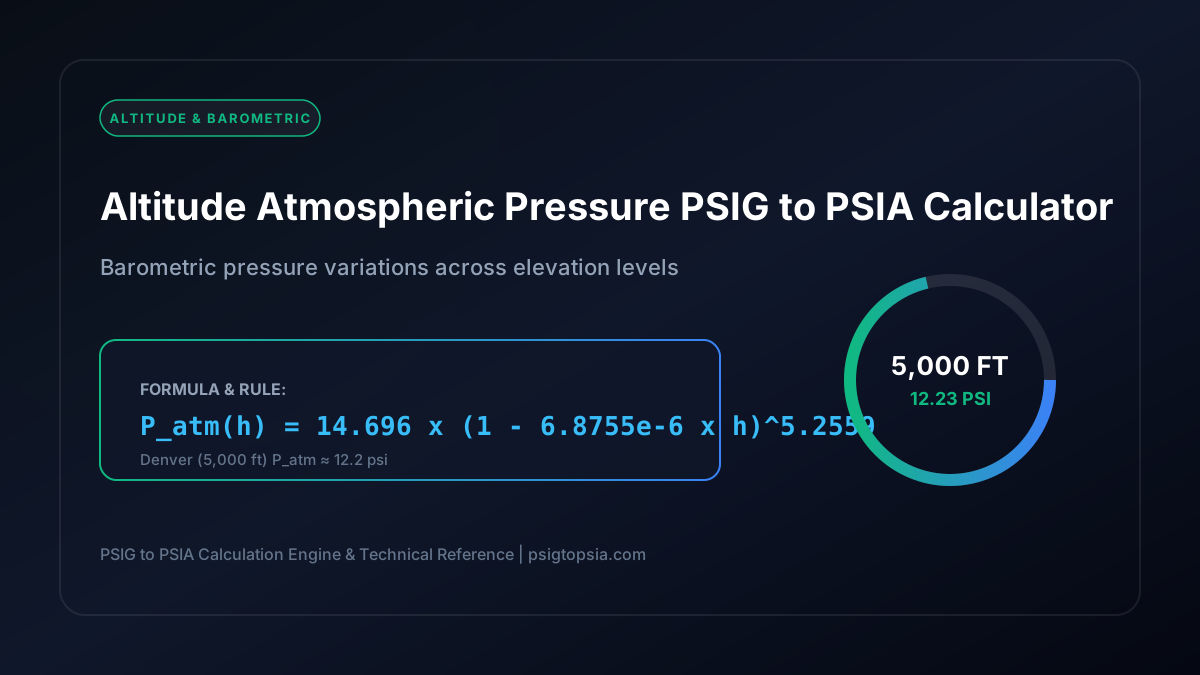
Adjusting for altitude atmospheric pressure in PSIG to PSIA conversions is required whenever operating above sea level. Earth’s atmospheric pressure decays continuously with elevation, meaning substituting standard sea-level pressure ($14.7\text{ psi}$) introduces significant calculation errors at altitude.
For local elevation pressure adjustments, use our online PSIG to PSIA calculator on the home page.
1. The Physics of Altitude Atmospheric Pressure & Barometric Decay
The US Standard Atmosphere model calculates ambient barometric pressure ($P_{\text{atm}}$) as a function of geometric altitude ($h$ in feet):
$$P_{\text{atm}}(h) = 14.696 \times \left(1 - 6.8755 \times 10^{-6} \times h\right)^{5.2559}$$
- Sea Level (0 ft): $P_{\text{atm}} = 14.7\text{ PSIA}$
- Denver, CO (5,280 ft): $P_{\text{atm}} = 12.2\text{ PSIA}$
- Mexico City (7,350 ft): $P_{\text{atm}} = 11.3\text{ PSIA}$
Read our complete comparison on PSIG vs PSIA difference explained.
2. Altitude Atmospheric Pressure Formulas: PSIG to PSIA & PSIA to PSIG
At high elevations, modify the conversion equation by inserting the local barometric pressure ($P_{\text{local}}$):
$$\text{PSIA} = \text{PSIG} + P_{\text{local}}$$
$$\text{PSIG} = \text{PSIA} - P_{\text{local}}$$
Quick answer: Altitude Atmospheric Pressure PSIG to PSIA
Answer: Atmospheric pressure drops by approximately 0.5 psi per 1,000 feet of elevation gain. In Denver, CO (5,280 ft altitude), atmospheric pressure is 12.2 PSIA. Thus, 14.7 PSIA to PSIG at 5,280 ft altitude yields 2.5 PSIG, whereas at sea level 14.7 PSIA to PSIG equals 0 PSIG.
3. Atmospheric Pressure & Elevation Conversion Reference Table
| Elevation / Location | $P_{\text{atm}}$ (PSIA) | 0 PSIG to PSIA | 14.7 PSIA to PSIG | 100 PSIG to PSIA |
|---|---|---|---|---|
| Sea Level (0 ft) | 14.7 PSIA | 14.7 PSIA | 0.0 PSIG | 114.7 PSIA |
| 1,000 ft (Atlanta) | 14.2 PSIA | 14.2 PSIA | 0.5 PSIG | 114.2 PSIA |
| 2,500 ft (Tucson) | 13.4 PSIA | 13.4 PSIA | 1.3 PSIG | 113.4 PSIA |
| 5,280 ft (Denver) | 12.2 PSIA | 12.2 PSIA | 2.5 PSIG | 112.2 PSIA |
| 7,350 ft (Mexico City) | 11.3 PSIA | 11.3 PSIA | 3.4 PSIG | 111.3 PSIA |
| 10,000 ft (Leadville) | 10.1 PSIA | 10.1 PSIA | 4.6 PSIG | 110.1 PSIA |
4. Key Elevation Benchmark Calculations
- 0 PSIA to PSIG (Denver): $0 - 12.2 = -12.2\text{ PSIG}$.
- 10 PSIA to PSIG (Denver): $10 - 12.2 = -2.2\text{ PSIG}$.
- 14.7 PSIA to PSIG (Denver): $14.7 - 12.2 = 2.5\text{ PSIG}$.
- 14.7 PSIA to PSIG (Sea Level): $14.7 - 14.7 = 0\text{ PSIG}$.
For standard sea level conversion steps, read how to convert PSIG to PSIA and how to convert PSIA to PSIG.
Calculate any elevation pressure value using our online PSIG to PSIA converter tool.
Related Resources
- PSIG to PSIA Tool: Homepage PSIG to PSIA Calculator – Online unit converter engine.
- PSIG to PSIA Guide: How to Convert PSIG to PSIA – Sea-level formula guide.
- PSIA to PSIG Guide: How to Convert PSIA to PSIG – Reverse conversion guide.
- PSIG vs PSIA Differences: PSIG vs PSIA Difference Explained – Zero reference comparison.
Frequently asked questions
How does altitude affect the PSIG to PSIA conversion?
As elevation increases, atmospheric pressure drops (decreasing by approx. 0.5 psi per 1,000 feet). Consequently, local atmospheric pressure must be used instead of 14.7 psi.
What is 14.7 PSIA to PSIG in Denver (5,280 ft altitude)?
At Denver's atmospheric pressure (12.2 PSIA), a pressure of 14.7 PSIA equals 2.5 PSIG (14.7 - 12.2 = 2.5 PSIG), whereas at sea level it equals 0 PSIG.
What is 0 PSIA to PSIG at high altitude?
0 PSIA (absolute vacuum) equals negative local atmospheric pressure in PSIG (-12.2 PSIG in Denver, -14.7 PSIG at sea level).